The Client: Master in the Field
Stephanie runs Master in the Field, a landscape design company based in the Etobicoke area of Toronto. When she came to Groundwork in early 2025, she had just launched the business. She had spent years working in sales before starting her own company, so she understood businesses, but she had never built one from scratch before, and she had never had to figure out how to get found online.
Her service area is competitive. The Toronto market has no shortage of landscaping companies, landscape designers, and contractors doing outdoor renovations. Standing out required more than just building a website. It required building the right website, targeting the right searches, and creating content that answered the specific questions her potential customers were asking.
The Problem: Completely Invisible Online
When Stephanie started with Groundwork, the situation looked like this:
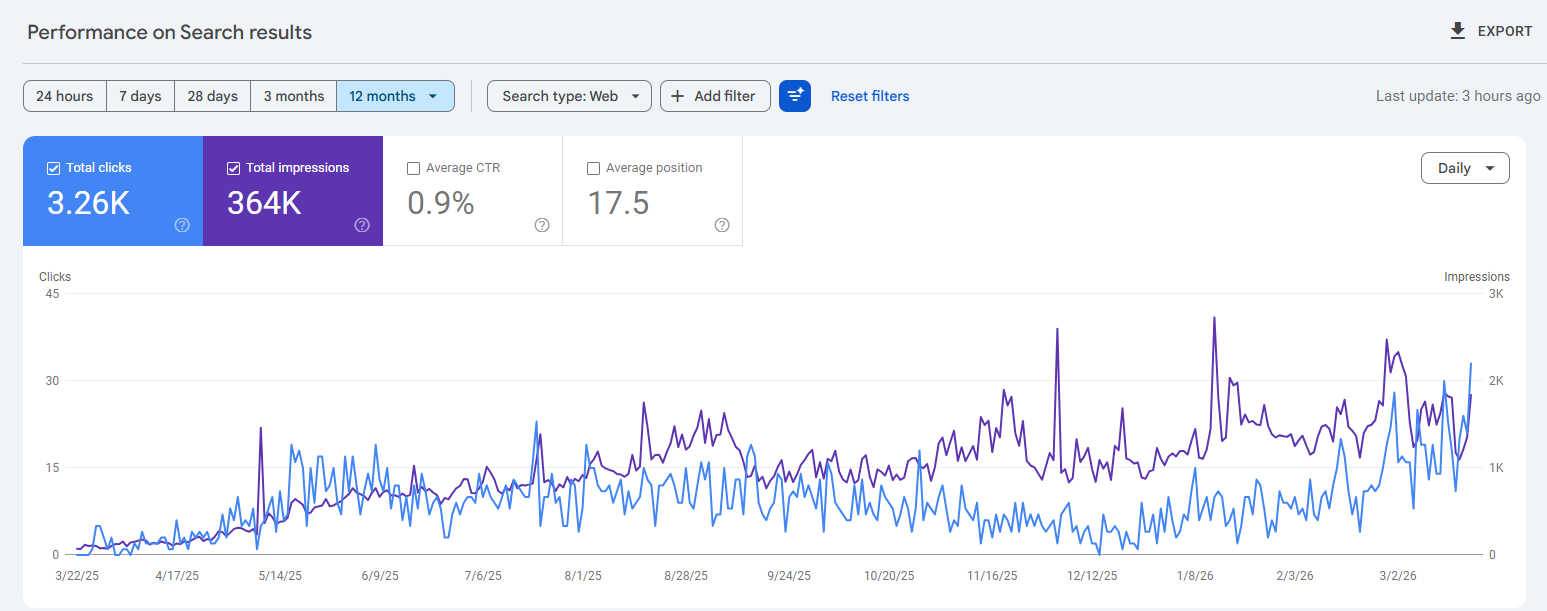
25 impressions per day on Google Search. That number represents how many times her website appeared anywhere in Google search results for any search query. Not 25 clicks. 25 times her website showed up, most of those in positions too low to click. For a business trying to generate inbound leads, that is effectively zero visibility.
Zero organic traffic. Zero leads from the website. A brand new business with no existing customer base, no referral network yet, and no online presence to bring in new customers.
The website existed but it was not working. It did not have separate pages for the specific services she offered. It did not target the location-specific searches her potential customers were making. It had no content that matched what a homeowner in Etobicoke or Toronto would type into Google when they were starting to think about a landscape renovation.
The business was invisible. Not because the service was bad. Because the search algorithm had no reason to show it to anyone.
What We Did
The strategy had two parts: build the right foundation first, then build content on top of it every week.
Part One: Build the Foundation
The first thing was fixing the website structure. We built out dedicated service pages for the main things Stephanie’s customers search for: backyard landscape design, front yard design, hardscaping, and outdoor living spaces. Each page was built around the specific search terms her customers actually use, not generic landscaping terms.
Then we built location-specific pages. “Landscape designer Etobicoke” is a much more specific search than “landscape designer Toronto,” and it is the kind of search that converts because the person already knows they want someone local. We built pages targeting Etobicoke, Mississauga, and the surrounding areas where Stephanie operates.
This is the part most landscaping companies skip. They have a website that says “we do landscaping” without ever telling Google specifically what kind of landscaping, for whom, and where. Google cannot rank a page for a search it does not know the page is relevant for.
Part Two: One Article Every Friday
Once the foundation was solid, Stephanie published one SEO-optimized article every Friday. Not generic content. Specific answers to the questions her potential customers were Googling before they hired anyone.
Articles like: backyard design ideas for small yards. Front yard landscaping ideas for Toronto homes. How much does landscape design cost in Etobicoke. What to plant for low-maintenance landscaping in Ontario.
Stephanie added her own photos to every article. Real photos from real projects she had completed. This did two things: it made the content more credible and more useful to readers, and it created visual proof of her work that helped convert visitors into leads.
The pace was consistent. One article per week, every week, for 13 months. Not a burst of content followed by silence. A steady, compounding publication schedule that gave Google more and more reason to treat Master in the Field as a credible, active resource for landscape design in the Toronto area.
The Results: Month by Month
The results did not happen overnight. Here is how they built over time.
March 2025 (Starting point): 25 impressions per day. No meaningful traffic. No leads from the website.
Early months (Spring 2025): The first content that broke through was a backyard design ideas article. Clicks jumped from near-zero to 5 to 10 per day almost immediately after it published. That was the proof of concept. The content was matching real searches, and Google was starting to notice.
June 2025 (Month 4): 100 visitors per month. The foundation pages were gaining traction. Multiple articles were ranking for long-tail searches. Organic traffic was building steadily.
Fall and Winter 2025: Content published during the slower season continued building. Off-season content targeting spring searches was ranking and accumulating traffic before the buying season started. This is the compounding effect of consistent SEO. Content does not stop working between seasons.
April 2026 (Month 13): 1,200 visitors in the previous 30 days. Ranking number one on Google for “landscape designer Etobicoke,” one of the most competitive local search terms in her market. Appearing in ChatGPT results when users ask about landscape designers in the Toronto area. Getting 5 to 6 inbound leads per month directly through the website. Zero paid ads at any point.
Stephanie is now turning away work. That is the outcome. A business that started with no online presence and no inbound leads now has more demand than she can take on. At 1,200 visitors a month and growing, the site now does the work of finding new clients.
What Made This Work
Three things, and the order they happened in matters.
First, the website was built correctly before any content was published. Service pages, location pages, proper technical structure. Google needs to understand what a website is about before it will rank it for anything. Skipping this step and jumping straight to content is like publishing articles that have no home. They do not compound. They disappear.
Second, the content matched real searches. Not topics Stephanie thought were interesting or that seemed like good ideas. Specific questions her customers were actually typing into Google. The difference between content that ranks and content that does not is almost always specificity. Generic landscaping content competes against every landscaping website on the internet. “Backyard design ideas for small Toronto yards” competes against a much smaller field.
Third, Stephanie showed up every Friday for 13 months. The results between month one and month four were not impressive. They were encouraging, but not transformational. The transformation happened between month four and month thirteen. That is the reality of SEO. The companies that quit after four months never see the results that come at month ten. Consistency over time is what converts steady effort into compounding returns.
What This Means for Other Landscaping Companies
Stephanie’s story is not unique to her. It is repeatable. Every element of this approach works for landscaping companies in competitive local markets because it is based on how Google and AI search systems actually work, not on tactics that may or may not hold up.
If you run a landscaping company and you are invisible online right now, the gap between where you are and where Stephanie is today is not as wide as it seems. It requires building the foundation correctly, publishing content consistently, and giving it time to compound. There is no shortcut, but there is a clear path.
The other thing worth noting: Stephanie started as a brand new business with zero existing customers and zero online presence. If this approach works from zero, it works from wherever you are starting. An established landscaping company with some existing traffic and some existing reviews has an even stronger starting point.
Frequently Asked Questions: Landscaping Marketing Case Study
How long did it take to get results?
The first signs of traction came within the first few months, with an article generating 5 to 10 clicks per day after publishing. Meaningful, consistent traffic started building around month 4 (100 visitors per month). The full transformation, 1,200 visitors per month and a number one ranking, happened at month 13. That timeline is realistic for a brand new business in a competitive market. Established businesses with existing domain authority often see results faster.
Did this require a big budget?
No paid ads were run at any point. The investment was in building the website foundation correctly and creating quality content consistently. That is not free in terms of time and professional support, but it is a fraction of what a sustained Google Ads campaign would cost to generate equivalent traffic. And unlike ads, the organic traffic does not stop when the budget does.
Why does Stephanie show up in ChatGPT results?
AI tools like ChatGPT and Perplexity pull information from websites they consider credible and relevant for a given search. A well-structured website with quality content, strong local signals, and genuine authority in a specific topic area is exactly what those systems look for. Building strong SEO also builds AI visibility. They are not separate strategies. See more about SEO for landscapers and how it connects to AI search.
Can this work for a landscaping company in a different city?
Yes. The principles are location-agnostic. The specifics change based on your market, your competition, and your service area, but the approach of building proper service and location pages and publishing consistent, search-matched content works in any local market. The timeline and the level of competition will vary.
What if I do not have time to write an article every week?
Stephanie took about an hour each Friday to write and publish her article. That is the time investment. The alternative is hiring someone to write the content for you, which Groundwork can help with, or publishing every two weeks instead of every week at the cost of a longer timeline to results. Consistency matters more than frequency. Every two weeks consistently beats every week for three months and then stopping.
Ready to Build This for Your Landscaping Company?
Stephanie’s results are real and they are documented. A landscape design business that started with nothing online, built the right foundation, showed up consistently, and ended up with 1,200 visitors a month and more inbound leads than she can take on. That is the outcome of doing this correctly.
If you run a landscaping company and you want to understand what this looks like for your specific market and situation, see how our landscaping marketing service works or learn more about our landscaping SEO approach. When you are ready to talk, reach out here and we will walk you through exactly where your online presence stands today and what it would take to get results like these. You can also see more on how Groundwork Agency works with contractors across trades.